
Building Your Online Presence
In 2026, the majority of customers looking for an electrician start their search online. If you're not visible on the internet, you're invisible to a huge portion of your potential market. Here's how to build a strong online presence:
Your own website: Even a simple one-page website with your name, services, area covered, contact details, and a few photos of your work is better than nothing. Platforms like Wix, Squarespace, or even a free Google Sites page can be set up in an afternoon. Include your competent person scheme registration number, insurance details, and genuine customer reviews. Budget: £0–£500 for a basic site.
Social media presence: At minimum, have a Facebook business page. Many customers will check your Facebook page to see reviews, photos of work, and how responsive you are. Post regularly — even one or two photos per week of completed jobs (with the customer's permission) builds credibility over time. Instagram works well for showcasing visual work like lighting installations, garden electrics, or neat consumer unit upgrades.
Online directories: Claim your listings on Yell, Thomson Local, FreeIndex, and any other relevant directories. These are free and help with local SEO — appearing in search results when someone types "electrician near me" or "electrician [your town]."
Consistency is key: Use the same business name, phone number, and address across all platforms. Search engines use this consistency (called NAP — Name, Address, Phone) as a trust signal. Inconsistent details confuse both customers and search algorithms.
Don't overthink this. A professional online presence doesn't require thousands of pounds or a marketing degree. It requires consistency, genuine content (real photos, real reviews), and keeping your information up to date.
Google Business Profile Optimisation
Your Google Business Profile (GBP) is arguably the single most important marketing tool for a local electrician. When someone searches "electrician near me" on Google, the results that appear on the map (the "local pack") come from Google Business Profiles. Getting into that top 3 map listing can transform your business.
Setting up and optimising your GBP:
- Complete every section: Business name, address, phone number, website, hours of operation, service area, business description, and categories. Google favours complete profiles. Choose "Electrician" as your primary category, and add secondary categories like "Electrical Installation Service" and "Emergency Electrician."
- Add photos regularly: Upload photos of completed work, your van, your team, and your tools. Google reports that businesses with photos receive 42% more requests for directions and 35% more click-throughs to websites. Aim for 5–10 new photos per month.
- Post updates: GBP has a "Posts" feature similar to social media. Use it to share offers, recent projects, or useful tips. Posts expire after 7 days, so consistency matters. Even one post per week signals to Google that your profile is active and current.
- Respond to all reviews: Reply to every review — positive and negative. Thank happy customers specifically (mention what you did for them). For negative reviews, respond professionally and constructively. Potential customers read your responses as much as the reviews themselves.
- Use the Q&A section: Seed your profile with common questions and answers: "Do you do free quotes?", "What areas do you cover?", "Are you NICEIC registered?". This helps customers and improves your profile's content.
Reviews are critical: The number and quality of Google reviews is the single biggest factor in local search ranking (after proximity to the searcher). Ask every satisfied customer for a review. Make it easy — send them a direct link to your review page via text message immediately after the job. A simple "Thanks for choosing us! If you were happy with the work, a Google review really helps: [link]" converts surprisingly well.
Aim for at least 30 reviews to appear credible. The top-ranking local electricians typically have 50–200+ reviews. Quality matters too — detailed reviews mentioning specific services ("replaced my consumer unit", "installed EV charger") help you rank for those specific search terms.
Customer Referral Systems
Word of mouth is the most powerful marketing channel for tradespeople, and a structured referral system turns happy customers into active promoters of your business. Here's how to build one:
The simple referral offer: After completing a job, leave a business card and tell the customer: "If you recommend me to a friend or neighbour and they book a job, I'll give you both £20 off." This reciprocal benefit motivates both the referrer and the new customer. Some electricians offer a free small service (changing a light fitting, for example) instead of a cash discount.
Follow-up strategy: Don't rely on customers remembering to recommend you. Follow up 2–4 weeks after a job with a brief text or email: "Hi [Name], hope you're happy with the [work done]. If any friends or neighbours need electrical work, I'd appreciate the recommendation. Thanks, [Your name]." This simple reminder can double your referral rate.
Leave-behind materials: Give customers 2–3 extra business cards or a small branded fridge magnet with your number. When their friend mentions they need an electrician, having your card to hand makes the recommendation frictionless. Fridge magnets in particular stay visible for years — a £1 investment that can generate multiple referrals.
Track and reward: Keep a simple spreadsheet of who referred whom. Thank referrers promptly — a quick text message ("Thanks for sending Mike my way, the £20 discount is on your next job") builds loyalty and encourages future referrals.
Over time, a well-run referral system can generate 30–50% of your work. It's the highest quality lead source because referred customers already trust you before you arrive, are less price-sensitive, and are more likely to refer others in turn. This virtuous cycle is the foundation of every successful local trades business.
Networking with Other Trades
Building relationships with complementary tradespeople is one of the most effective — and most overlooked — ways to grow your electrical business. Plumbers, builders, kitchen fitters, bathroom installers, estate agents, and letting agents all regularly encounter situations where their customers need an electrician.
How to build trade relationships:
- Reciprocal recommendations: Find a plumber, a builder, and a decorator whose work you respect. Agree to recommend each other to your respective customers. This informal network can generate 5–10 jobs per month once established.
- Kitchen and bathroom companies: Kitchen and bathroom showrooms often need reliable electricians for their installations. Introduce yourself, show your credentials, and offer competitive trade pricing. A single kitchen company can provide steady work throughout the year.
- Estate agents and letting agents: Letting agents need electricians for EICRs (legally required every 5 years for rental properties), remedial work, and general maintenance. Estate agents encounter electrical issues during property sales. Build relationships with 3–5 local agents and you'll have a consistent stream of work.
- Property developers and builders: Even small-scale developers need first and second fix electricians. The work is often larger and more predictable than domestic call-outs. Attend local networking events or simply introduce yourself at building sites in your area.
Maintaining relationships: Don't just ask for referrals — give them. When a customer asks if you know a good plumber, recommend your network contact. Send the occasional text to check in. Share useful leads when they come up. The best trade networks are genuine two-way relationships built on mutual respect and trust.
Join your local business breakfast group, BNI chapter, or trades networking event if one exists in your area. The monthly cost (typically £20–£50) is easily recovered from one or two referrals per quarter.
Platform Strategies: Sparky, Checkatrade, and Others
Trade platforms connect electricians with customers who need work done now. They can be a valuable source of leads, especially for newer businesses building their reputation. Here's how to use them effectively:
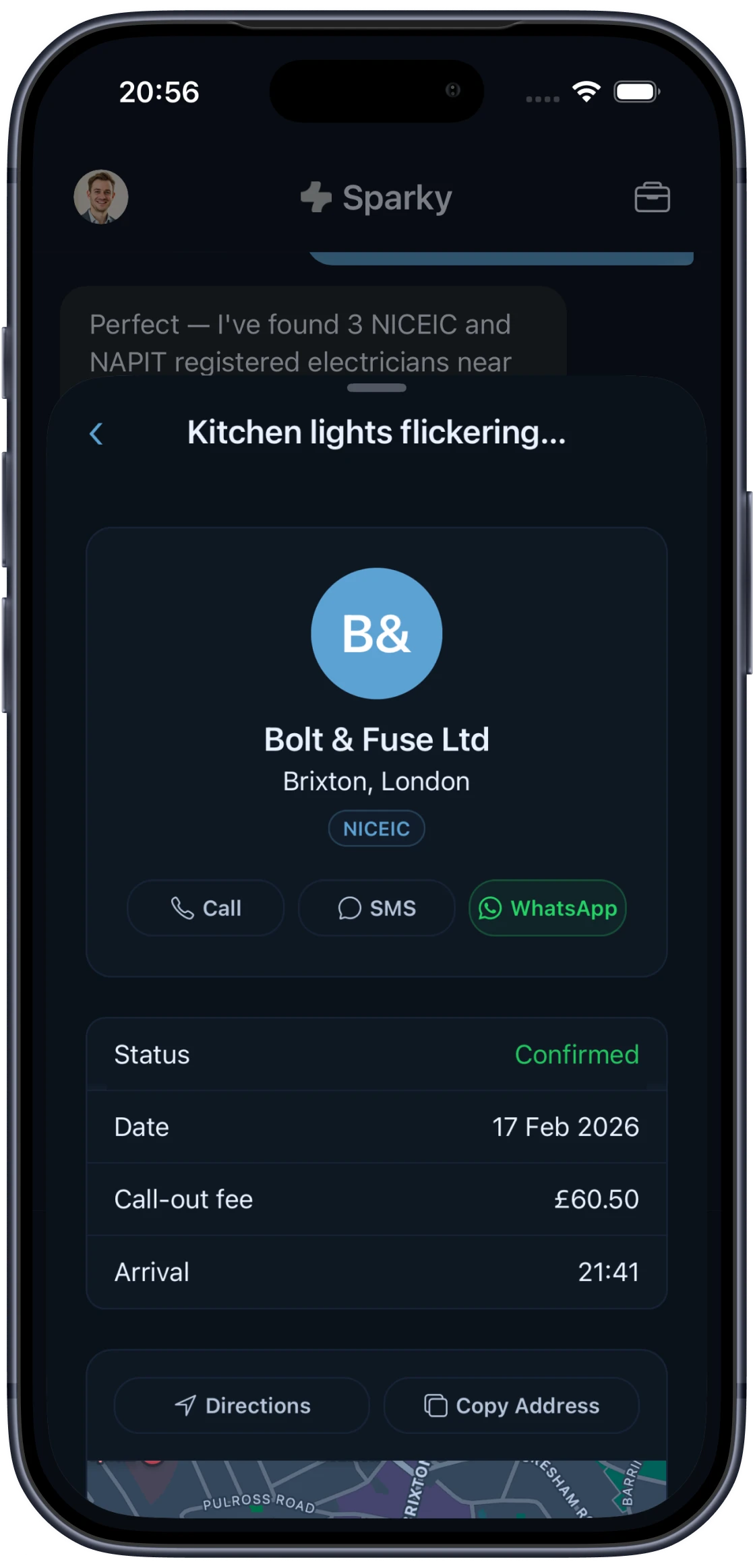
Sparky: Sparky uses AI to match customers with the right electrician for their specific job. You receive jobs that are relevant to your skills and location, with transparent pricing that the customer has already agreed to. There's no per-lead fee — you're matched with customers who are ready to book. This eliminates the time-wasting associated with leads that don't convert.
Checkatrade: One of the most established platforms. Monthly subscriptions start from approximately £60–£120 per month depending on the categories and area you want to cover. Checkatrade's strength is brand recognition — many customers specifically search for "Checkatrade electrician." The platform includes a review system and vetting badge that builds trust.
MyBuilder: A lead-based platform where you express interest in posted jobs and the customer chooses from shortlisted tradespeople. Lead costs vary by job type. MyBuilder works well for larger jobs (rewires, EV chargers) where the lead cost is a small percentage of the total job value. Less effective for small jobs where the lead cost might eat into your margin.
Rated People: Similar to MyBuilder in model. You buy credits and spend them expressing interest in relevant jobs. Pricing is competitive and the platform has good brand recognition.
Tips for platform success:
- Respond quickly: On most platforms, the first responder has a significant advantage. Set up mobile notifications and aim to respond within 15 minutes during working hours.
- Complete your profile thoroughly: Full profiles with photos, qualifications, insurance details, and reviews consistently outperform bare-bones listings.
- Collect reviews on every platform: Reviews are the primary trust signal for platform customers. After every job, ask the customer to leave a review on the platform you found them through.
- Track your ROI: Record which platforms generate leads, which leads convert to jobs, and what each platform costs per converted job. Drop platforms that aren't delivering a positive return and reinvest in those that are.
Commercial vs Domestic Work
As your business grows, you'll face a choice between focusing on domestic (residential) work, commercial (business) work, or a mix of both. Each has distinct advantages and challenges:
| Factor | Domestic | Commercial |
|---|---|---|
| Average job value | £100–£2,000 | £1,000–£50,000+ |
| Payment terms | Usually on completion | 14–60 day invoices |
| Competition | High — many sole traders | Lower — requires additional qualifications |
| Work predictability | Reactive, variable | More predictable, longer projects |
| Relationship | One-off or occasional repeat | Ongoing contracts possible |
| Additional requirements | Part P, DBS if appropriate | CSCS/ECS card, risk assessments, method statements |
Moving into commercial work: If you want to take on commercial projects (office fit-outs, retail units, small industrial), you'll need:
- An ECS (Electrotechnical Certification Scheme) card — required on most commercial sites
- Competence in commercial wiring systems (trunking, containment, three-phase)
- Risk assessment and method statement experience (often abbreviated as RAMS)
- Potentially higher insurance cover (£5–£10 million public liability is often specified)
- The ability to read and work from electrical design drawings
A balanced approach: Many successful electrical businesses maintain a domestic base (for steady, predictable income) while taking on commercial projects for higher-value work. This diversification protects you against downturns in either market. Domestic work keeps the cash flowing while commercial projects boost your annual turnover.
Seasonal Planning
Electrical work has seasonal patterns that savvy electricians can plan around to maintain a consistent income throughout the year:
Peak periods (September–December):
- Outdoor lighting and garden electrics in early autumn (customers preparing for darker months)
- Heating-related electrical work (storage heater repairs, thermostat installations)
- Pre-Christmas rush (customers wanting work completed before the holidays)
- Landlord EICR renewals (many leases and letting agent schedules cluster around autumn)
Steady periods (January–March):
- New Year renovation projects (many homeowners plan work over the Christmas break)
- Emergency work increases (harsh weather exposes electrical faults)
- Commercial fit-outs (businesses starting new financial year projects)
Growth periods (April–August):
- EV charger installations (peak season as weather improves)
- Extensions and renovations (building season means electrical first and second fix work)
- Garden and outdoor electrics (lighting, power to sheds and offices)
- Solar panel installations and associated electrical work
Quieter periods: Use any quiet spells productively:
- Update your website and social media
- Complete training or CPD (continuing professional development)
- Service and calibrate your test equipment
- Follow up with past customers who mentioned future work
- Build relationships with other trades and letting agents
- Plan marketing campaigns for the upcoming busy period
Tracking your income by month over 2–3 years reveals your personal seasonal pattern. Once you understand it, you can proactively market services that match seasonal demand: promote EV chargers in spring, outdoor lighting in summer, and emergency services in winter. This smooths out your income and keeps your diary full year-round.





Social Media for Electricians
Social media might not seem like a natural fit for electricians, but it's a powerful tool for building local awareness and trust. You don't need to be a social media expert — consistency and authenticity matter more than polish.
What to post (and what works):
Platform priorities:
Spend 10–15 minutes per day on social media — post one thing, respond to comments and messages, and engage with a few local posts. That's enough to build a meaningful presence over time.