Legal Requirements: The Electrical Safety Standards
The Electrical Safety Standards in the Private Rented Sector (England) Regulations 2020 made it a legal requirement for all private landlords in England to have the electrical installations in their rental properties inspected and tested by a qualified person. These regulations apply to all new tenancies from 1 July 2020 and all existing tenancies from 1 April 2021.
Under the regulations, landlords must:
- Ensure that national standards for electrical safety are met — this means the installation must at minimum not be dangerous, though ideally it should fully comply with BS 7671
- Have the electrical installations inspected and tested by a qualified and competent person at intervals of no more than five years
- Obtain an Electrical Installation Condition Report (EICR) following each inspection
- Supply a copy of the EICR to existing tenants within 28 days of the inspection
- Supply a copy to new tenants before they occupy the property
- Supply a copy to the local housing authority within seven days if requested
In Wales, similar obligations exist under the Renting Homes (Wales) Act 2016, which requires landlords to ensure electrical installations are in a "fit and proper condition" and to have a valid EICR. Scotland has had electrical safety requirements for private rented housing since 2015 under the Housing (Scotland) Act 2006.
These regulations apply to the fixed electrical installation — the wiring, sockets, light fittings, consumer unit, and earthing arrangement. They do not cover portable appliances (which fall under separate PAT testing guidance) or tenant-owned equipment.
How Often Do You Need an EICR?
The regulations specify a maximum interval of five years between inspections. However, there are situations where more frequent testing may be required or advisable:
- Between tenancies: While not legally required for every changeover, many letting agents and insurers recommend an EICR at each change of tenancy, particularly if the previous report was more than two or three years old
- If the inspector recommends a shorter interval: The qualified person conducting the EICR can recommend a shorter re-inspection period if they identify issues that warrant closer monitoring. This recommendation appears on the report and should be followed
- After significant electrical work: If you've had rewiring, a consumer unit replacement, or other major electrical work carried out, a new EICR or Electrical Installation Certificate should be obtained
- For HMOs: Houses in Multiple Occupation have always required electrical inspections, typically every five years, as a condition of their HMO licence
It's worth noting that the five-year cycle starts from the date of the most recent satisfactory report. If your EICR is dated March 2022, you need a new one by March 2027. Don't wait until the last minute — booking an inspection a few months early gives you time to address any issues before the deadline.
For landlords with multiple properties, creating a simple spreadsheet tracking EICR dates, expiry dates, and any remedial actions required is an effective way to stay compliant. Missing a deadline — even by a few weeks — exposes you to enforcement action.
What Happens During an EICR Inspection
An EICR inspection is a thorough examination and testing of the fixed electrical installation in the property. The process typically takes 2–4 hours for a standard two or three-bedroom property, longer for larger or older homes with more complex installations.
During the inspection, the qualified person will:
- Visual inspection: Check the consumer unit, wiring accessories (sockets, switches, light fittings), cable routes, and earthing arrangements for visible damage, wear, or non-compliance
- Dead testing: With the power safely isolated, test continuity of protective conductors, insulation resistance between conductors, and polarity of circuits
- Live testing: With power restored, measure earth fault loop impedance (Zs) at each circuit endpoint, RCD trip times, and prospective fault current at the origin of the installation
- Sampling: For periodic inspections, testing is conducted on a representative sample of circuits and accessories (typically 10–25% of points), with more extensive testing if issues are found
The inspector will need access to the consumer unit, all rooms in the property, the loft space (if accessible), and any outbuildings with electrical supplies. Tenants should be informed in advance and asked to keep areas clear. The power will need to be turned off for parts of the inspection, usually for 30–60 minutes.
At the end of the inspection, the qualified person produces the EICR document listing the condition of the installation and any observations or deficiencies. This is a formal document that must be kept on file and supplied to tenants and authorities as required.
Understanding EICR Results and Codes
EICR results use a coding system to classify any deficiencies found. Understanding these codes is essential for knowing what action you need to take and how quickly:
| Code | Classification | Required Action |
|---|---|---|
| C1 | Danger present | Immediate remedial action required — risk of injury. The inspector may disconnect the dangerous circuit on the spot. |
| C2 | Potentially dangerous | Urgent remedial action required — the deficiency could become dangerous under certain conditions. |
| C3 | Improvement recommended | Not dangerous but not to current standards. No legal requirement to act, but advisable to improve safety. |
| FI | Further investigation required | The inspector has identified something that needs more detailed examination to determine its condition. |
An EICR with any C1, C2, or unresolved FI code is classified as "unsatisfactory". Under the 2020 regulations, landlords must complete remedial work for dangerous items within 28 days (or less if specified by the inspector), or within the timescale set by the local authority if they are involved. Where further investigation is required, landlords should arrange that follow-up promptly rather than treating FI as a harmless note.
C3 observations do not make the report unsatisfactory, but they flag areas where the installation doesn't meet current BS 7671 standards. While there's no legal obligation to address C3 items, doing so improves safety and may prevent them from deteriorating into C2 issues at the next inspection.
After remedial work is completed, you must obtain written confirmation from a qualified person that the issues have been resolved. This confirmation — often in the form of a minor works certificate or updated EICR — must be supplied to tenants within 28 days and to the local authority if requested.
Penalties for Non-Compliance
The penalties for failing to comply with the Electrical Safety Standards regulations are severe and have been actively enforced since the regulations took effect. Local housing authorities have the power to impose financial penalties of up to £30,000 for each breach.
Breaches that can attract penalties include:
- Failing to have a valid EICR for a rented property
- Failing to carry out remedial work for C1 or C2 deficiencies within the required timeframe
- Failing to provide a copy of the EICR to tenants within the required timeframe
- Failing to provide a copy to the local authority when requested
The penalty amount is determined by the local authority based on factors including the severity of the breach, the landlord's compliance history, and their financial circumstances. A first-time offence for a minor administrative failure (late submission to a tenant) will attract a lower penalty than repeated failures to inspect a property with dangerous wiring.
Beyond financial penalties, non-compliance can have serious consequences for landlords:
- Section 21 notices: In England, you cannot serve a valid Section 21 "no-fault" eviction notice if you haven't provided the tenant with a copy of a valid EICR
- Insurance implications: If an electrical incident occurs in a property without a valid EICR, your landlord insurance may not pay out
- Civil liability: If a tenant is injured by a faulty electrical installation that should have been identified by an EICR, the landlord faces significant personal liability
- Rent repayment orders: Tenants can apply for a rent repayment order if the landlord has committed a housing offence
The cost of compliance — typically £150–£300 for an EICR every five years — is negligible compared to the potential penalties and risks of non-compliance. There is no reasonable justification for failing to meet these obligations.
Tenant Rights and Responsibilities
Tenants have specific rights under the Electrical Safety Standards regulations, and understanding these is important for both landlords and tenants.
Tenant rights include:
- Receiving a copy of the most recent EICR before moving in (for new tenancies) or within 28 days of the inspection (for existing tenancies)
- Requesting a copy of the EICR at any time during the tenancy
- Being informed about any remedial work required and when it will be carried out
- Reporting concerns about electrical safety to the local housing authority, who have a duty to investigate
- Applying for a rent repayment order if the landlord fails to meet their obligations
Tenant responsibilities include:
- Allowing reasonable access for the inspection to take place — the landlord must give appropriate notice (usually 24–48 hours), but tenants should not unreasonably refuse access
- Not tampering with the fixed electrical installation — this includes DIY wiring, modifications to sockets or switches, and interference with the consumer unit
- Reporting any electrical problems to the landlord promptly — burning smells, sparking, frequent tripping, or discoloured sockets should be reported immediately
- Taking reasonable care of the electrical installation — not overloading sockets, using appliances safely, and not damaging wiring
If a tenant refuses to allow access for an EICR inspection after reasonable notice has been given, the landlord should document all attempts to arrange access. This evidence can demonstrate that the landlord has taken all reasonable steps to comply, which is a defence against enforcement action.
Choosing a Qualified Inspector
The regulations require that inspections are carried out by a "qualified and competent person." This is not defined as strictly as some landlords assume, but in practice it means an electrician who holds the right qualifications and is registered with a recognised scheme.
A qualified inspector should hold:
- A Level 3 qualification in electrical installations (or equivalent experience)
- The current 18th Edition Wiring Regulations certificate (BS 7671)
- The 2391 inspection and testing qualification (or legacy 2394/2395)
- Registration with a competent person scheme — NICEIC, NAPIT, ELECSA, or equivalent
When choosing an inspector, consider the following:
- Verify their credentials: Check their registration on the relevant scheme's website. Both NICEIC and NAPIT have online directories where you can search by name, company, or postcode.
- Ask for their ECS card: The Electrotechnical Certification Scheme card confirms their qualifications and that they have valid CSCS health and safety accreditation.
- Get a clear price: EICR costs for a standard 2–3 bedroom property in 2026 range from £150 to £250 outside London and £200 to £350 in London. Be wary of very cheap prices (under £100), which may indicate a superficial inspection.
- Check what's included: A good inspector will include the full EICR report, schedule of test results, and (if registered with a competent person scheme) notification to the local authority. Check whether remedial work pricing is available upfront.
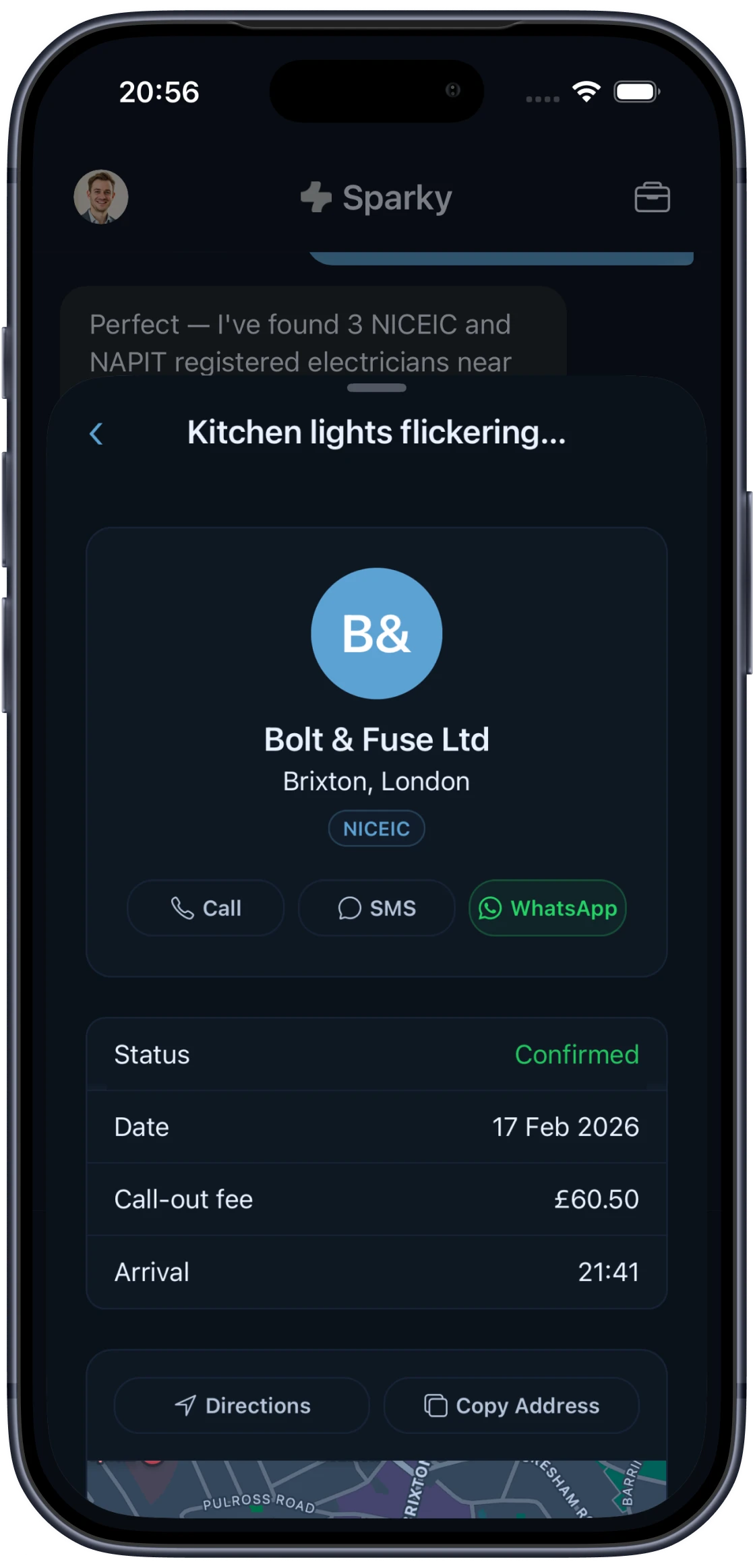
Using a platform like Sparky can simplify the process — describe what you need, and we'll match you with a qualified, registered electrician in your area who can carry out the EICR and any necessary remedial work.