Cost Breakdown
| Item | Min | Max | Note |
|---|---|---|---|
| 1-bed flat | £2500 | £4000 | Typically takes 3-5 days; smaller area but access can be limited in purpose-built flats |
| 2-bed house or flat | £3500 | £5500 | Most common budget rewire; 5-7 days for a terraced or semi-detached property |
| 3-bed semi-detached house | £5000 | £8000 | The most frequently quoted rewire job in the UK; usually takes 7-10 days |
| 4-bed detached house | £7000 | £12000 | Larger properties with more circuits and longer cable runs; expect 10-14 days |
| 5-bed detached house | £10000 | £15000 | Extensive wiring needed; 14-21 days depending on layout and number of floors |
| Partial rewire (per circuit) | £350 | £800 | Replacing individual circuits rather than a full rewire; cost depends on cable run length |
| Materials (cable, consumer unit, accessories) | £800 | £3000 | Twin-and-earth cable, consumer unit, sockets, switches, junction boxes, fixings |
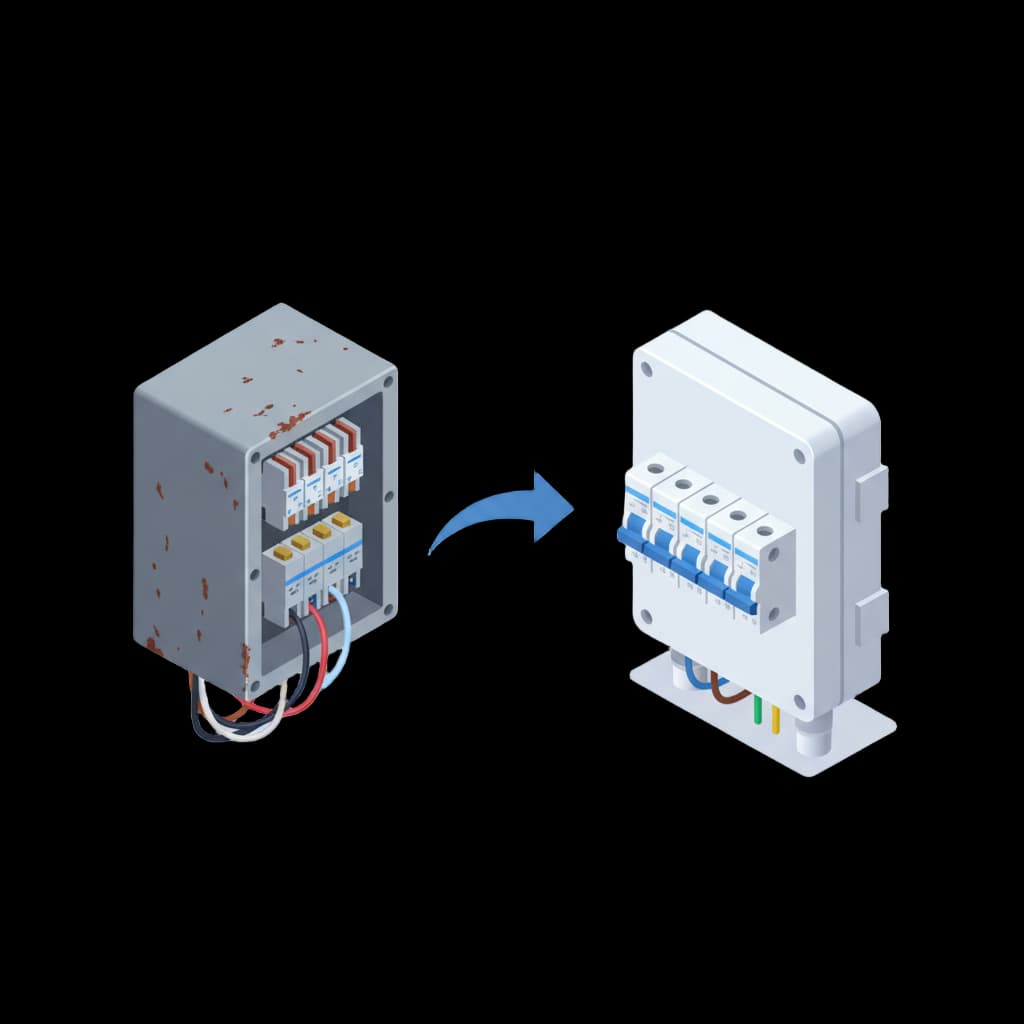
| New consumer unit (fuse box) | £350 | £800 | Dual-RCD board £350-£500, full RCBO board £550-£800; included in most full rewire quotes |
| Labour per day (qualified electrician) | £250 | £450 | London rates are typically 20-30% higher than national average; most jobs need 2 electricians |
| Part P certification (Building Regulations) | £150 | £350 | Building control notification and Electrical Installation Certificate (EIC) included |
| Making good (plastering and decoration) | £500 | £2500 | Often quoted separately; covers plastering over cable chases in walls and ceilings |
What's Included
- Complete removal of all old wiring (rubber, lead-sheathed, or PVC) and replacement with new twin-and-earth cables to BS 7671 (18th Edition) standard
- New consumer unit (fuse box) with RCD or RCBO protection on all circuits, including surge protection device (SPD) as required by current regulations
- New double sockets throughout — typically 2-4 per room depending on size and use, with twin sockets in living areas and bedrooms
- New light switches (1-gang or 2-gang) and ceiling roses for every room, including landing and hallway
- Dedicated radial circuits for high-power appliances: cooker (32A), electric shower (40A+), immersion heater, and electric vehicle charger if required
- Ring main circuits for general socket outlets on each floor, with separate circuits for kitchen appliances
- Smoke alarm circuit — hardwired interlinked smoke and heat detectors as required by current Building Regulations
- Full testing and inspection of the completed installation with an Electrical Installation Certificate (EIC)
- Building control notification under Part P of the Building Regulations (England and Wales) — your electrician handles this if registered with NICEIC, NAPIT, or similar competent person scheme
- Basic making good — some electricians include filling and plastering over cable chases, though this varies between contractors
Factors Affecting Cost
- Property size and number of bedrooms — the single biggest factor. A 1-bed flat needs roughly 6-8 circuits, while a 5-bed house may need 20+ circuits with far longer cable runs
- Number of floors — multi-storey properties require more vertical cable runs between floors, additional time routing through floor voids, and potentially scaffolding for external entry points
- Property age — Victorian and Edwardian homes (pre-1930) often have lath-and-plaster walls, lime mortar, and solid floors that are slower and harder to chase and route cables through. Expect 15-25% more than a modern build
- Wall construction — solid brick walls take longer to chase than stud partition walls. Period properties with ornate plasterwork may need careful routing to avoid damage
- Accessibility — limited loft access, concrete ground floors, and properties with no crawl space all increase labour time. Flats above the ground floor add complexity for routing cables
- Number of sockets and circuits required — modern homes typically need far more than older wiring provided. Adding extra sockets, USB charging points, outdoor power, and dedicated circuits for cookers, showers, and EV chargers increases cost
- Consumer unit specification — a basic dual-RCD board costs £350-£500, while a full RCBO board (individual protection per circuit) costs £550-£800. RCBO boards are increasingly standard for new installations
- Location — London and the South East are consistently 20-30% more expensive than the Midlands, North, Scotland, and Wales due to higher labour rates and operating costs
- Making good and redecoration — some electricians include basic plastering over cable chases, while others quote this separately. Full redecoration is almost never included and should be budgeted for as a separate cost
- Whether the property is occupied — rewiring an empty property is faster and cheaper. Working around furniture, carpets, and occupants adds 10-20% to the labour cost
- Asbestos — older properties may have asbestos in textured coatings (Artex), insulation boards, or around old wiring. If asbestos is found, removal must be carried out by a licensed contractor before rewiring can proceed, adding £500-£2,000+
How Long Does It Take?
A full house rewire typically takes between 5 and 21 days depending on property size, age, and complexity. Here is what to expect by property type: a 1-bed flat usually takes 3-5 days, a 2-bed house 5-7 days, a 3-bed semi-detached house 7-10 days, a 4-bed detached house 10-14 days, and a large 5-bed property 14-21 days. These timescales cover the electrical work only — you should allow an additional 2-5 days for plastering and making good, plus time for redecoration. The property will be without power for periods during the work, though a competent electrician will maintain supply to at least one circuit wherever possible. If two electricians work on the job simultaneously (common for larger properties), the timeline can be reduced by 20-30%. First fix (running cables behind walls and under floors) takes roughly 60% of the total time, while second fix (fitting sockets, switches, and the consumer unit) takes the remaining 40%. Most electricians will agree a schedule before starting so you know what to expect each day.
Do I Need This?
You should consider a full house rewire if your property has any of these warning signs: old rubber-insulated or lead-sheathed wiring (common in homes built before the 1960s), a fuse box with rewirable fuses rather than modern MCBs, round-pin sockets (typically Bakelite), fabric or rubber cable sheathing visible at sockets or in the loft, frequent blown fuses or tripped circuits, scorch marks or discolouration around sockets or switches, a burning smell from outlets, flickering lights not caused by bulb issues, or an EICR (Electrical Installation Condition Report) that has flagged C1 (danger present) or C2 (potentially dangerous) observations. Mortgage lenders and home insurers may also require evidence of safe wiring before approving a mortgage or providing cover. If your wiring is over 25-30 years old, it is worth having an EICR to assess its condition even if you are not experiencing obvious problems — the test costs £150-£300 and could save you from a dangerous situation. Rewiring is also the ideal time to modernise your electrical installation by adding extra sockets, USB charging points, outdoor power, smart lighting circuits, and a dedicated EV charger circuit. Planning a rewire alongside a kitchen or bathroom refit makes sense as these rooms will already have disruption.
How to Save Money
Get at least 3 detailed quotes from NICEIC or NAPIT registered electricians — ensure each quote specifies the same number of circuits, sockets, consumer unit specification, and whether making good is included, so you are comparing like-for-like
Have the work done while the property is empty (before you move in, during a renovation, or while on holiday) to reduce labour time by 10-20% and avoid the need to work around furniture and belongings
Do the making good and redecoration yourself or hire a plasterer and decorator separately — some electricians charge a significant premium for this work that a specialist would do for less
Combine the rewire with other planned work such as a kitchen refit, bathroom renovation, or loft conversion to reduce overall disruption and potentially negotiate a package rate
Consider a partial rewire if an EICR shows only certain circuits need replacing — this can save 40-60% compared to a full rewire, though mixing old and new wiring has limitations
Ask about first fix only pricing if you are comfortable arranging the plastering and second fix decoration independently — this splits the job into stages and can reduce the upfront outlay
Avoid peak season (spring and summer) when electricians are busiest — booking for autumn or winter may get you a better rate and faster availability
Use our free rewiring cost calculator to get an instant estimate based on your specific property before requesting quotes, so you know what to expect
Average Cost Summary
£2500–£15000
Typical price range for house rewiring cost uk 2026 in the UK. Prices may vary based on your location, property type, and specific requirements.
Partial vs Full Rewire
A partial rewire replaces only the circuits that are faulty or dangerous, leaving the rest of the existing wiring in place. A full rewire replaces every cable, socket, switch, and the consumer unit throughout the entire property. The right choice depends on the condition of your existing wiring, as determined by an EICR.
A partial rewire typically costs £350-£800 per circuit, so replacing 3-4 problem circuits in a 3-bed house might cost £1,500-£3,000 — a significant saving compared to a full rewire at £5,000-£8,000. However, partial rewires have limitations: the remaining old wiring will still age and may need replacing within a few years, junction points between old and new wiring require careful installation, and some mortgage lenders or insurers may not accept a partial rewire as sufficient.
A full rewire is recommended when the EICR shows widespread C1 or C2 observations, when the wiring is rubber or lead-sheathed (pre-1960s), when the property has no earthing or inadequate earthing, or when you are planning major renovations anyway. If your electrician recommends a full rewire, ask them to explain the EICR findings so you understand why.
Rewiring Costs by Region
Rewiring prices vary significantly across the UK. London is the most expensive region, with prices typically 20-30% above the national average. The South East (Surrey, Kent, Sussex, Berkshire) is 10-20% above average. The Midlands, East Anglia, and South West sit close to the national average. The North of England, Wales, and Scotland are generally 10-15% below the national average, though city centres (Manchester, Edinburgh, Cardiff) are closer to the average.
For a typical 3-bed semi-detached house, here is what to expect by region in 2026: London £6,500-£10,000, South East £5,500-£8,500, Midlands £5,000-£7,500, North of England £4,500-£7,000, Wales £4,500-£6,500, Scotland £4,500-£7,000. These figures include all materials, labour, consumer unit, testing, and Part P certification. Making good is sometimes included and sometimes quoted separately — always clarify this when comparing quotes.
The regional price difference is driven primarily by labour rates, which reflect local cost of living, commercial rents, parking and congestion charges, and competition levels. Materials cost roughly the same nationwide.
What Happens During a Rewire
Understanding the rewiring process helps you prepare and set expectations. A full rewire follows a clear sequence: survey, first fix, second fix, testing, and certification.
The electrician starts with a survey of the existing installation, noting the position of every socket, switch, and appliance point. They will agree the layout of the new installation with you — this is your chance to add extra sockets, move switch positions, or plan for future needs like EV charging or a home office.
First fix is the most disruptive phase. The electrician chases channels in walls and ceilings to run new cables, lifts floorboards to route cables through floor voids, drills through joists and walls, and installs back boxes for sockets and switches. Dust and debris are unavoidable. This phase takes roughly 60% of the total job time.
After first fix, a plasterer fills and smooths the chased channels. Once plaster is dry, second fix begins: fitting socket faceplates, light switches, light fittings, the consumer unit internals, and connecting everything. This is much less disruptive.
Finally, the electrician performs a full schedule of testing — insulation resistance, earth continuity, polarity, RCD trip times, and more. If everything passes, they issue an Electrical Installation Certificate (EIC) and notify building control. The property is then safe, compliant, and ready for redecoration.
Building Regulations and Part P
All full rewires in England and Wales must comply with Part P of the Building Regulations. This means the work must be designed, installed, inspected, and tested to BS 7671 (the IET Wiring Regulations, currently the 18th Edition with Amendment 2). There are two routes to compliance.
The most common route is using an electrician registered with a competent person scheme — NICEIC, NAPIT, ELECSA, STROMA, or similar. Registered electricians can self-certify their own work without involving local council building control. They issue the certificates directly and notify the local authority on your behalf. This is included in their quote.
The alternative is to hire a non-registered electrician and apply to your local council for building control approval. This typically costs £200-£400 and involves council inspectors visiting the property to check the work at first fix and second fix stages. This route is slower and more expensive, so using a registered electrician is strongly recommended.
In Scotland, the Building (Scotland) Regulations 2004 apply. SELECT is Scotland's trade body for electrical contractors. In Northern Ireland, Part P does not apply, but work must still comply with BS 7671 and local building control requirements.
On completion, you should receive three documents: an Electrical Installation Certificate (EIC), a Building Regulations Compliance Certificate (from the competent person scheme or local authority), and a schedule of test results. Keep these safe — you will need them when selling the property.
Signs Your House Needs Rewiring
Not sure whether your property needs a rewire? Here are the most common warning signs, in order of urgency.
Immediate danger signs (get an electrician urgently): scorch marks, burning smell, or heat around sockets and switches; sparks when plugging in or unplugging appliances; fuses blowing or circuits tripping repeatedly; any socket or switch that feels warm to the touch when not in use.
Strong indicators you need a rewire: a fuse box with rewirable fuses (ceramic holders with wire) rather than modern MCBs; round-pin sockets — these indicate pre-1960s wiring; cables with rubber, lead, or fabric sheathing visible in the loft, under floors, or at socket back boxes; no earth wire (older installations used the metal conduit as earth, which degrades over time); light switches with round rocker switches or brass toggle switches from the 1950s-60s.
Time-based indicators: your property was built before 1970 and has never been rewired; the last rewire was more than 25-30 years ago; you have no record of the wiring age and cannot find an EIC or EICR.
The definitive check is an EICR (Electrical Installation Condition Report), carried out by a qualified electrician. This costs £150-£300 and tests every circuit, grading each as C1 (danger present — immediate action needed), C2 (potentially dangerous — urgent remedial action needed), C3 (improvement recommended), or FI (further investigation required). Any C1 or C2 results mean the wiring is unsafe and rewiring should be prioritised.
Get a Rewiring Quote
Ready to get an accurate estimate? Use our free house rewiring cost calculator to see what a rewire should cost based on your specific property — enter your property type, number of bedrooms, floors, and region to get an instant estimate. Then get quotes from local electricians through Sparky to compare real prices.
When requesting quotes, make sure each electrician visits the property to survey the existing installation. A quote based on a phone description alone is unlikely to be accurate. Ask each electrician to specify: the number of circuits, sockets, and switches included; the consumer unit specification (dual-RCD vs RCBO); whether making good is included; the estimated timeline; and their competent person scheme registration (NICEIC, NAPIT, ELECSA, or SELECT in Scotland). Comparing like-for-like ensures you are making a fair comparison and helps avoid unexpected additional charges during the work.