Establishing Emergency Procedures
Every property manager should have documented emergency electrical procedures before an emergency occurs. Attempting to establish procedures during a crisis — when power is out, alarms are sounding, or there is a risk of fire — leads to delays, poor decisions, and increased risk to building occupants.
An effective emergency electrical procedure should cover the following elements:
- Definition of an electrical emergency — clearly define what constitutes an emergency versus a routine fault. An electrical emergency is any situation that presents an immediate risk to life or property, including: exposed live conductors, burning smell from electrical equipment, electrical fire, complete power loss to essential safety systems (fire alarm, emergency lighting, lifts), electric shock to a person, or flooding affecting electrical installations
- Reporting channels — how building occupants, security staff, and cleaning contractors should report an electrical emergency. This should include an out-of-hours contact number that is staffed or diverted at all times
- Initial response actions — what the first responder should do before an electrician arrives. This typically includes isolating the affected circuit (if safe to do so), evacuating the affected area if necessary, calling the emergency services if there is a fire or someone has received an electric shock, and contacting the property manager or duty manager
- Escalation matrix — who should be contacted, in what order, for different types of emergency. This should include the emergency electrician, the property manager (or out-of-hours duty manager), the building owner or client, the fire and rescue service (for electrical fires), and the DNO (for supply failures or damage to the incoming supply)
- Location of isolation points — all building staff and security personnel should know the location of the main isolator, distribution boards, and any local isolation points for high-risk equipment. This information should be displayed prominently and included in staff induction training
The emergency procedures should be documented in a format that is accessible under pressure — a laminated A3 flowchart displayed in the security office and building management suite is more useful during an emergency than a 20-page procedure document filed in a cabinet.
Staff training is essential. All building staff, security personnel, and reception staff should be trained on the emergency procedures at induction and at least annually thereafter. Training should include practical exercises such as locating and operating the main isolator, and tabletop scenarios to test decision-making and communication.
The emergency procedures should be reviewed at least annually, after any significant building alteration, and after every emergency event. Lessons learned from real emergencies should be incorporated into updated procedures.
Triage and Assessment
Not every electrical problem is an emergency, and treating routine faults as emergencies wastes money and contractor resources while potentially delaying the response to genuine emergencies. Effective triage is essential for managing electrical issues proportionately.
Category 1 — Immediate danger (emergency callout required):
- Electric shock to a person — call 999 immediately, do not touch the person if they are still in contact with the electrical source, and isolate the supply if safe to do so
- Electrical fire or burning smell — activate the fire alarm, evacuate, call 999, and do not attempt to fight the fire unless it is very small and you have appropriate training and equipment. Never use water on an electrical fire
- Exposed live conductors — evacuate the area, prevent access, and arrange an emergency electrician
- Complete failure of fire alarm or emergency lighting systems — this leaves the building without critical safety systems and constitutes an emergency, particularly during occupied hours
- Flooding or water ingress affecting electrical installations — isolate the supply to the affected area and arrange an emergency inspection
Category 2 — Urgent (same-day or next-day response):
- Partial power loss affecting occupied areas but no immediate safety risk
- Repeated RCD tripping on a circuit serving occupied areas
- Failure of a single fire alarm zone (where other zones remain operational)
- Failure of emergency lighting on one floor (where other floors remain covered)
- Sparking or arcing from a socket or switch (isolate the circuit and schedule urgent repair)
- Intermittent power fluctuations that could indicate a loose connection
Category 3 — Routine (scheduled within normal maintenance):
- Individual socket or light switch failure in a non-critical area
- Cosmetic damage to switches or socket faceplates
- Replacement of failed lamps in non-essential lighting
- Minor C3 defects identified during EICR inspection
- Timer or sensor adjustments on lighting systems
Triage decision-making:
The person receiving the report must be trained to ask the right questions to categorise the situation correctly. Key questions include:
- Is anyone hurt or in immediate danger?
- Is there a fire, smoke, or burning smell?
- Can you see any exposed wires or damage to electrical equipment?
- Which areas are affected — is it localised or building-wide?
- Are any safety systems (fire alarm, emergency lighting) affected?
- Has the main supply tripped, or is it a localised circuit fault?
A structured triage script ensures consistent decision-making regardless of who receives the call. This is particularly important for out-of-hours calls handled by security staff or an external monitoring centre.
Contractor Arrangements
Having a reliable emergency electrician on standby is a non-negotiable requirement for property managers. The time to find an emergency contractor is before you need one, not during a crisis at 2 AM on a Saturday.
Pre-agreed contractor arrangements:
Property managers should establish a formal agreement with one or more emergency electrical contractors that covers:
- Response times — maximum time from call to arrival on site. For genuine emergencies, a 2-hour response time within London is a reasonable expectation. For urgent (Category 2) callouts, a same-day or next-business-day response is appropriate
- 24/7 availability — the contractor must provide genuine round-the-clock coverage, including weekends and bank holidays. This means the contractor has electricians on call or on rotation, not simply a voicemail that will be checked in the morning
- Agreed rates — emergency callout rates should be pre-agreed to avoid billing disputes during stressful situations. Typical emergency callout rates in London range from £150-£300 for the first hour (including travel), with hourly rates of £60-£120 thereafter. Out-of-hours and weekend/bank holiday premiums are standard but should be specified in the agreement
- Competence requirements — the contractor must be registered with a competent person scheme (NICEIC, NAPIT, or ELECSA), hold adequate public liability insurance (minimum £2 million for commercial work), and carry the relevant test equipment to diagnose and resolve faults
- Access arrangements — ensure the contractor has the necessary access information, including building access codes, key holder details, location of distribution boards, and any permit-to-work requirements
Backup arrangements:
No single contractor can guarantee availability 100% of the time. Property managers should have at least one backup contractor arrangement for situations where the primary contractor is unavailable. This backup should have the same pre-agreed terms and access information.
Using Sparky for emergency callouts:
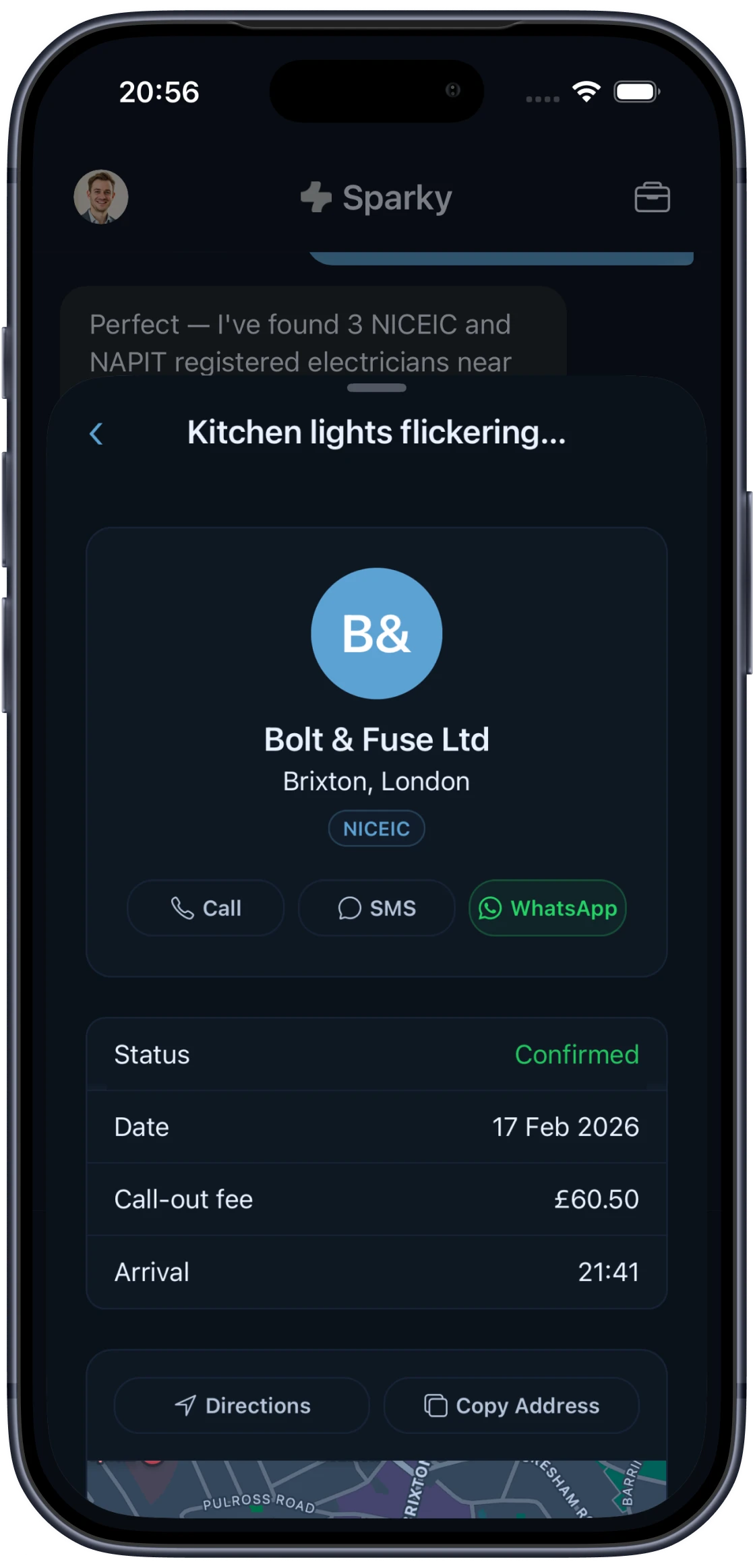
Services like Sparky can connect property managers with available electricians quickly, even outside normal working hours. The advantage is access to a network of vetted, qualified electricians rather than relying on a single contractor. This can be particularly valuable as a backup arrangement or for property managers who do not have the volume to justify a dedicated contractor agreement.
Contractor vetting:
Before appointing any emergency electrician — whether through a formal agreement or a platform like Sparky — property managers should verify:
- Registration with a competent person scheme (check the register online)
- Current public liability insurance certificate
- DBS check status (particularly important for residential properties and buildings with vulnerable occupants)
- Experience with commercial and multi-tenanted buildings (residential house electricians may not be comfortable working on three-phase commercial installations or complex fire alarm systems)
Communication Protocols
Effective communication during an electrical emergency is as important as the technical response. Poor communication leads to confusion, delayed decisions, and loss of confidence from building occupants and clients.
Internal communication:
- Initial notification — the property manager or duty manager should be notified immediately of any Category 1 or Category 2 electrical incident. A standard notification format should include: what has happened, where in the building, who is affected, what immediate actions have been taken, and what the current status is
- Ongoing updates — during an extended incident, provide updates at regular intervals (every 30 minutes for Category 1 events, hourly for Category 2). Even if there is no change, confirming "no update, contractor still working on site" prevents unnecessary escalation calls
- Resolution notification — when the emergency is resolved, send a clear confirmation including: what the fault was, what was done to fix it, whether the fix is permanent or temporary, and whether any follow-up work is needed
Communication with building occupants:
- During the incident — if the incident affects occupied areas (power loss, evacuation, restricted access), notify occupants promptly with clear, factual information. Avoid technical jargon. State what is happening, what areas are affected, what occupants should do (e.g., evacuate, avoid certain areas, remain in their units), and when the next update will be provided
- Communication channels — use all available channels: building PA system, email to occupant contact lists, notices on affected floors, and direct communication through reception or concierge staff. For residential buildings, door-to-door notification may be necessary if the incident affects safety systems
- After resolution — notify occupants that the incident has been resolved and normal operations have resumed. If any temporary measures are in place (e.g., temporary lighting, reduced capacity), explain these clearly
Communication with building owners and clients:
- Building owners and management company clients should be notified of any significant electrical emergency, particularly those involving safety risks, building evacuations, or significant costs
- Provide a factual summary of the incident, the response, the resolution, and any costs incurred or anticipated. Avoid speculation about causes until the post-emergency investigation is complete
- Where the emergency reveals a compliance deficiency (e.g., a failed fire alarm system that was overdue for its annual inspection), be transparent about this and present a plan to address the underlying issue
Communication with authorities:
- Electrical incidents causing death or serious injury must be reported to the HSE under RIDDOR (Reporting of Injuries, Diseases and Dangerous Occurrences Regulations 2013). This is a legal obligation with a strict reporting deadline
- Electrical fires should be reported to the fire and rescue service, who may investigate the cause and issue enforcement action if fire safety failures are identified
- The DNO should be notified of any damage to the incoming supply or meter equipment
Post-Emergency Actions
The period after an electrical emergency is resolved is critical. The immediate danger may have passed, but the actions taken in the following hours and days determine whether the underlying cause is identified, whether the fix is permanent, and whether the incident recurs.
Immediate post-emergency checks:
- Verify that all safety systems are fully operational — fire alarm, emergency lighting, lifts, access control, and ventilation. If any system was isolated or affected during the emergency, confirm that it has been restored to full operation
- Confirm that any temporary measures are safe and appropriate for the period they will be in place. For example, if a temporary cable run has been installed, ensure it is protected from damage, does not create a trip hazard, and is appropriately rated for the load
- If the emergency resulted in an evacuation, carry out a sweep of the building before allowing re-occupation to confirm that there are no remaining hazards
Root cause investigation:
Every electrical emergency should be investigated to determine the root cause. The depth of investigation should be proportionate to the severity of the incident, but even minor incidents can reveal underlying issues that, if left unaddressed, could cause more serious problems in the future.
- What failed? — identify the specific component, circuit, or system that caused the emergency
- Why did it fail? — was it age-related deterioration, mechanical damage, overloading, a manufacturing defect, or a previous installation error?
- Could it have been prevented? — would the failure have been identified by the existing PPM programme? If not, does the PPM programme need to be enhanced?
- Are there similar risks elsewhere? — if a distribution board failed due to age-related deterioration, are there other distribution boards of similar age and type in the building or portfolio that should be inspected?
Documentation:
- Record the full details of the emergency in the building's maintenance log, including the date and time, the nature of the fault, the immediate actions taken, the contractor who attended, the diagnosis, the repair carried out, and whether the repair is temporary or permanent
- If the emergency involved a fire alarm system fault, record it in the fire alarm log book
- If the emergency involved electrical injury, complete a RIDDOR report and record it in the accident book
- Retain all contractor invoices, reports, and photographs for insurance and compliance purposes
Permanent repair planning:
If the emergency repair was temporary, plan the permanent repair promptly. Temporary fixes have a tendency to become permanent if not actively managed. Set a clear deadline for the permanent repair, allocate budget, and schedule the work. The temporary-to-permanent transition should be tracked on the PPM system.
Procedure review:
After every electrical emergency, review the emergency procedures. Did the triage process work correctly? Was the contractor response time acceptable? Was communication with occupants effective? Were building staff able to locate the isolation point quickly? Use the review findings to update the procedures, retrain staff if necessary, and address any gaps identified during the real-world test of the system.
Insurance notification:
Depending on the nature and cost of the emergency, notify the building's insurer. Many policies require prompt notification of incidents that may give rise to a claim. Even if you do not intend to claim, notifying the insurer protects against later disputes about late notification. Provide factual details and supporting documentation including the contractor's report and photographs.
Key Takeaways
- ✓Establish documented emergency procedures before an emergency occurs — a laminated flowchart in the security office is more useful than a 20-page document in a filing cabinet.
- ✓Pre-agree contractor terms, rates, and response times — the time to negotiate is not during a crisis at 2 AM.
- ✓Train all building staff on emergency procedures at induction and annually, including practical exercises locating isolation points.
- ✓Effective triage distinguishes genuine emergencies from urgent and routine faults, ensuring proportionate responses and efficient use of resources.
- ✓Every electrical emergency should trigger a root cause investigation and a review of emergency procedures.
- ✓Document everything — incident details, contractor reports, and costs — for compliance, insurance, and continuous improvement purposes.