What is this?
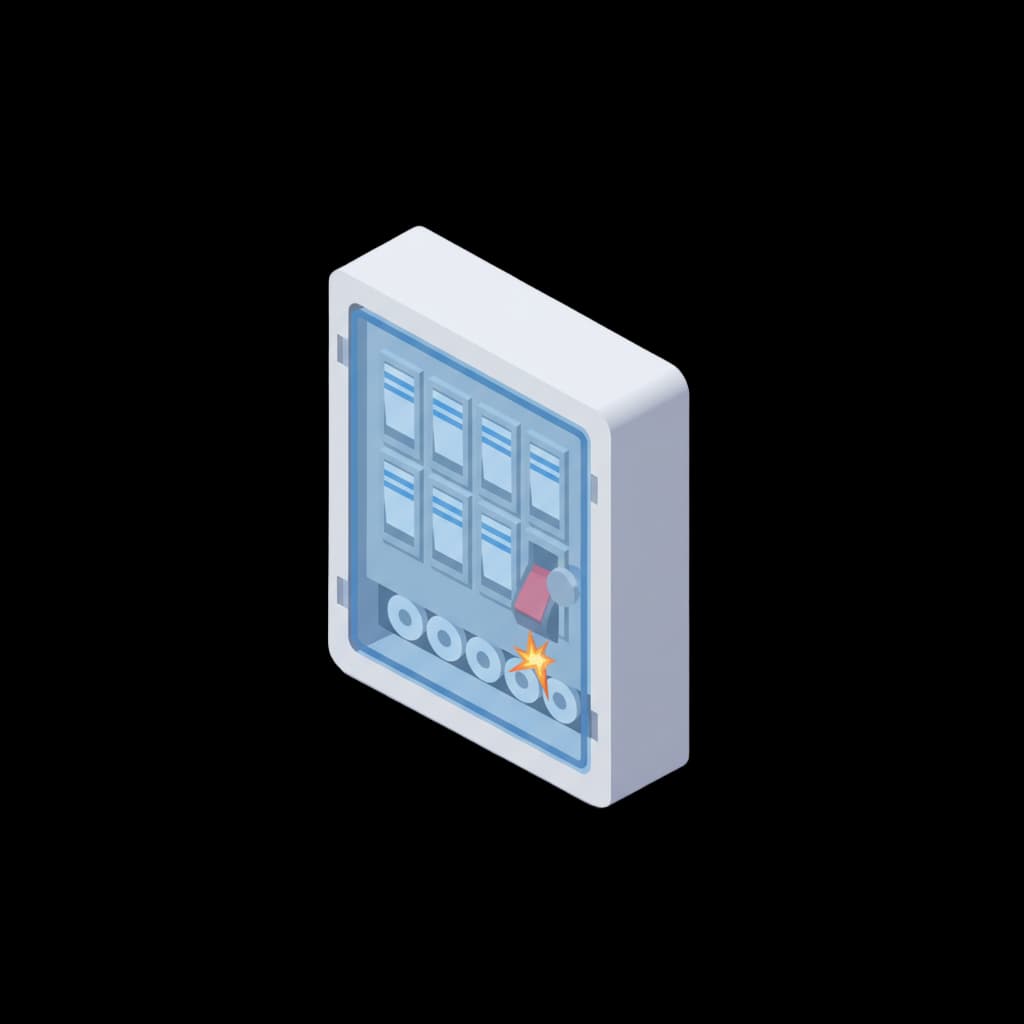
An RCD (Residual Current Device), sometimes called a residual current device or trip switch, is a life-saving safety device fitted inside your consumer unit (fuse box). It continuously monitors the balance of electrical current flowing through the live and neutral conductors. Under normal conditions, the current flowing out through the live wire and returning through the neutral should be equal. If the RCD detects a difference (or imbalance) of 30 milliamps or more — meaning current is leaking to earth through an unintended path such as a person, water, or damaged insulation — it trips within 40 milliseconds, disconnecting the power before serious harm can occur. If your RCD keeps tripping, it is detecting a genuine earth leakage fault somewhere in your electrical installation or in an appliance connected to it. While the RCD tripping is actually a sign that your protection is working, the underlying cause always needs investigating.
Common causes
- Faulty appliance with a breakdown in its internal insulation — the most common cause of RCD tripping in UK homes. Washing machines, tumble dryers, dishwashers, and kettles are frequent culprits as their heating elements degrade over time
- Damaged cable or wiring with degraded insulation, allowing current to leak to earth. This is especially common in older properties with rubber or lead-sheathed wiring that has become brittle with age
- Moisture or condensation in a socket, junction box, light fitting, or outdoor enclosure. Even small amounts of dampness can create an earth leakage path that exceeds the 30mA threshold
- Faulty or deteriorating RCD that has become oversensitive or is reaching the end of its service life. RCDs should be replaced every 10–15 years, and older mechanical types are more prone to nuisance tripping
- Accumulated small leakage currents from multiple appliances. Individually each appliance may leak only 2–5mA (which is normal), but when several are connected to circuits protected by the same RCD, the combined leakage can exceed 30mA
- Outdoor wiring or garden equipment exposed to damp conditions — garden lights, pond pumps, hot tub circuits, and external sockets are particularly vulnerable
- EV charger installation on a standard Type AC RCD instead of the required Type A or Type B RCD, causing unwanted tripping from DC fault current components
- Rodent damage to cable insulation inside walls, lofts, or under floors
- Incorrectly wired circuits, particularly where a neutral from one circuit has been connected to another circuit (a crossed neutral)
- Immersion heater or electric shower with a failing heating element that allows current to leak through the water to earth
Is it dangerous?
An RCD tripping is actually a sign that your safety device is working correctly — it is doing its job by disconnecting the power before anyone gets hurt. However, the underlying fault that the RCD is detecting could be genuinely dangerous. Earth leakage faults can cause electric shocks, and in some cases they can generate enough heat to start a fire. Never disable, bypass, or tape down an RCD to keep it from tripping. Do not remove the RCD from your consumer unit. If you keep resetting it without investigating the cause, you risk exposing yourself and your household to the very danger the RCD is designed to protect against.
Can I fix it myself?
You can often identify the source of the problem using a process of elimination. Start by switching off every MCB (miniature circuit breaker) that is protected by the tripping RCD. Then try to reset the RCD. If the RCD resets and holds with all MCBs off, turn them back on one at a time, waiting a few seconds between each. When one MCB causes the RCD to trip again, you have found the faulty circuit. Next, switch off that MCB, reset the RCD, and unplug every appliance on the faulty circuit. Turn the MCB back on. If the RCD holds, plug your appliances back in one at a time. The appliance that causes the RCD to trip is your culprit — stop using it and have it repaired or replaced. If the RCD still trips with nothing plugged in on that circuit, the fault is in the fixed wiring and you need a qualified electrician.
When to call an electrician
Call a qualified electrician if you cannot identify the faulty circuit or appliance using the isolation method above, if the RCD trips with nothing plugged in (which indicates a fixed wiring fault), if it trips immediately every time you try to reset it, or if you notice any burning smell, scorch marks, or discolouration around your consumer unit. You should also call an electrician if your consumer unit has only one RCD covering all circuits, as any single fault will take out your entire electrical supply. If the tripping is intermittent and you cannot reliably reproduce it, an electrician can carry out insulation resistance testing and install monitoring equipment to catch the fault.
What will an electrician do?
Perform RCD function tests using a calibrated RCD tester to confirm the device itself is operating within specification — tripping at the correct current and within the required time
Carry out insulation resistance (IR) testing on each circuit to measure the level of earth leakage and identify which circuit or circuits have degraded insulation
Perform a loop impedance test to verify the earth fault path is adequate and to rule out issues with the earthing system
Use a process of elimination to systematically isolate the faulty circuit, then narrow down to the specific cable run, fitting, or accessory
Inspect wiring, connections, junction boxes, and fittings on the faulty circuit for signs of damage, moisture ingress, overheating, or rodent damage
Repair or replace the source of the fault — whether that is a section of cable, a damaged socket or light fitting, a faulty appliance connection, or a waterlogged outdoor enclosure
Test the RCD again after the repair to confirm the fault is fully resolved and the device is holding
Recommend upgrading to an RCBO board if nuisance tripping is a recurring problem, so that future faults only affect the individual circuit rather than multiple circuits or the whole house
Typical cost
£100 – £300
For fault-finding and repair on a single circuit. A straightforward diagnosis where the electrician identifies a faulty appliance or a single damaged connection is typically at the lower end. If the fault is in the fixed wiring and requires tracing a cable run through walls or floors, expect costs toward the higher end. Replacing the RCD itself adds £40–£80 for the device plus fitting. A full RCBO consumer unit upgrade ranges from £500–£900 including labour, testing, and certification.
Step-by-step troubleshooting
Before calling an electrician, you can often narrow down the cause of your RCD tripping using a systematic isolation process. This is safe to do as long as you are only operating switches in your consumer unit — you do not need to open the unit or touch any wiring.
Switch off every MCB (the smaller switches) that is protected by the tripping RCD. These are usually the MCBs directly below or beside the RCD switch.
Try to reset the RCD by pushing it firmly to the ‘on’ position. If it will not reset with all MCBs off, the fault may be in the RCD itself or the consumer unit wiring — call an electrician.
If the RCD resets and holds, turn the MCBs back on one at a time, waiting 5–10 seconds between each. Watch the RCD carefully.
When one MCB causes the RCD to trip, you have identified the faulty circuit. Note which MCB it is — it may be labelled (e.g. ‘Kitchen sockets’, ‘Upstairs lights’).
Switch off the faulty MCB and reset the RCD again. Go around the house and unplug every appliance and device on that circuit.
Turn the faulty MCB back on. If the RCD holds, the fault is in one of the appliances you unplugged. Plug them back in one at a time until the RCD trips again — that appliance is your culprit.
If the RCD trips with everything unplugged on that circuit, the fault is in the fixed wiring (cables in the walls, ceiling, or floor). Do not attempt to fix this yourself — call a qualified electrician.
Appliances that commonly trip RCDs
Certain household appliances are far more likely to develop earth leakage faults than others. Appliances with heating elements, motors, or exposure to water are the most common culprits because their internal components degrade over time and allow current to leak to earth.
Tumble dryers
Tumble dryers are one of the most frequent causes of RCD tripping in UK homes. The heating element operates at high temperatures and is exposed to moisture and lint, which accelerates insulation breakdown. When the element degrades, current leaks through the metal drum and casing to earth. The fault may only appear during certain parts of the drying cycle, making it intermittent and hard to catch. If your tumble dryer is tripping the electric, stop using it immediately and have the element tested. Replacement elements are relatively inexpensive, but if the dryer is old, replacement may be more economical.
Washing machines
Washing machines combine water, heat, and moving parts — all of which contribute to earth leakage over time. A failing heating element is the most common cause, but worn door seals that allow water to reach electrical connections, corroded terminal blocks, and damaged suppressor capacitors can also cause RCD tripping. The fault may only appear at certain points in the wash cycle, such as when the heater activates or during the spin.
Dishwashers
Like washing machines, dishwashers combine water and heating elements. The heating element that dries the dishes is the usual suspect. Salt and mineral deposits from hard water can also create leakage paths. If your dishwasher is tripping the RCD, check for water leaks underneath the machine first — many dishwashers have a float switch that should cut power if water is detected in the base, but this may not prevent RCD tripping.
Electric ovens and cookers
Oven elements operate at very high temperatures and can develop hairline cracks in their insulation over years of use. These cracks allow current to leak to the metal oven body. The fault may only appear when the oven reaches a certain temperature, so it can seem intermittent. If your oven trips the RCD only when hot, the element almost certainly needs replacing.
EV chargers
EV chargers are an increasingly common cause of RCD tripping, particularly when the electrical installation has not been set up correctly. Electric vehicle chargers can produce DC fault currents during charging, which standard Type AC RCDs cannot detect reliably. This can cause nuisance tripping or, more dangerously, failure to trip when a real fault occurs. The IET Code of Practice for Electric Vehicle Charging Equipment Installation requires at least a Type A RCD for chargers with built-in DC detection, or a Type B RCD for chargers without. If your EV charger was installed on a standard RCD, have the installation reviewed by a qualified electrician.
Electric showers
Electric showers draw a very high current (typically 8–10.8 kW) and are in direct contact with water. Over time, the heating element can develop faults that allow current to leak through the water to earth. Hard water areas are particularly affected as limescale builds up on the element. If your electric shower trips the RCD, do not continue using it — the combination of water and electrical fault is extremely dangerous.
RCD tripping intermittently vs constantly
How frequently your RCD trips provides important clues about the type of fault you are dealing with.
Constant tripping — where the RCD trips immediately every time you try to reset it — usually indicates a significant, active fault. This could be a dead short to earth, a heavily water-damaged fitting, or a catastrophically failed appliance. The fault is serious enough that even a brief moment of power allows enough leakage current to trip the RCD. An electrician should be able to find this type of fault relatively quickly using insulation resistance testing.
Intermittent tripping — where the RCD trips at seemingly random times and may hold for hours or days between trips — is much harder to diagnose. The fault is not constant, which means something is changing. Common causes of intermittent tripping include: appliances that only leak at certain points in their operating cycle (such as a washing machine during the heat phase); moisture that accumulates gradually and then dries out; loose connections that vibrate into contact intermittently; and thermal effects where cable insulation breaks down when warm and recovers when cool.
If your RCD tripping is intermittent, keep a log of when it happens. Note the time, what appliances were running, and the weather conditions (dampness and rain are significant factors). This information is extremely useful for an electrician diagnosing the fault. In difficult cases, an electrician can install a data logger that monitors leakage current continuously and records exactly when and on which circuit the leakage exceeds the threshold.
RCD types explained
Not all RCDs are the same. There are several types designed to detect different kinds of fault current, and using the wrong type can cause nuisance tripping or — more dangerously — failure to trip when needed.
Type AC
The most basic type of RCD, designed to detect sinusoidal (pure AC) earth fault currents only. Type AC RCDs were standard in older installations but are no longer recommended for general use in the UK because many modern appliances (particularly those with electronic controls, LED drivers, and switch-mode power supplies) can produce non-sinusoidal fault currents that a Type AC RCD may not detect.
Type A
Detects both sinusoidal AC and pulsating DC fault currents. Type A is now the minimum standard recommended by BS 7671 for most domestic circuits. It covers the fault current types produced by the majority of modern household appliances, including those with electronic controls, variable speed drives, and Class I IT equipment.
Type B
Detects sinusoidal AC, pulsating DC, and smooth DC fault currents. Type B RCDs are required for circuits supplying equipment that can produce smooth DC fault currents, such as some EV chargers (those without built-in DC detection), three-phase variable speed drives, and certain medical equipment. Type B RCDs are significantly more expensive than Type A (typically £150–£300 per device).
Type F
A relatively new type specifically designed for circuits supplying single-phase frequency inverters (such as those in modern washing machines with variable speed motors, air conditioning units, and heat pumps). Type F RCDs detect the mixed-frequency fault currents that these devices can produce.
Why your RCD trips with nothing plugged in
If your RCD trips even when every appliance on the circuit is unplugged, the fault is in the fixed wiring — the cables, connections, and fittings that are permanently installed in your walls, floors, and ceilings. This is known as an insulation fault or isolation fault, and it always requires a qualified electrician to diagnose and repair.
Common causes of fixed wiring faults include cables where the insulation has degraded with age (particularly rubber-insulated wiring from before the 1970s), cables that have been damaged by nails, screws, or staples during DIY work or building alterations, moisture trapped in junction boxes or ceiling roses, corroded connections in back boxes behind sockets and switches, and rodent damage to cable insulation in lofts, cavity walls, or under floors.
An electrician will use an insulation resistance tester (often called a "megger") to measure the resistance between the circuit conductors and earth. A healthy circuit should read at least 1 megohm. Readings significantly below this indicate damaged insulation. The electrician can then isolate sections of the circuit to narrow down exactly where the fault is located.
How much does it cost to fix RCD tripping?
The cost of fixing an RCD that keeps tripping depends mainly on how quickly the electrician can find the fault and what needs to be done to fix it.
Diagnosis and simple repair
If the fault is a single faulty appliance or an obvious issue like a waterlogged outdoor socket, the electrician may resolve it within an hour. Expect to pay £100–£150 for a callout that includes diagnosis and a straightforward repair.
Complex fault-finding
If the fault is in the fixed wiring and requires systematic testing of multiple circuits, or if the fault is intermittent and requires extended diagnosis, expect to pay £150–£300. Some electricians charge a fixed rate for fault-finding, while others charge by the hour (£50–£80/hour is typical in the UK outside London, £70–£120/hour in London).
RCD replacement
If the RCD itself is faulty and needs replacing, the device costs £40–£80 plus £50–£100 labour. The total is typically £100–£180.
RCBO upgrade
If nuisance tripping is a persistent problem, upgrading your consumer unit to a full RCBO board is the most comprehensive solution. This costs £500–£900 including the unit, labour, testing, and an Electrical Installation Certificate. Each circuit gets its own combined RCD/MCB protection, so a fault on one circuit never affects any other.
RCD installation cost
If your consumer unit does not currently have RCD protection (common in older properties with rewireable fuse boxes), having an RCD added costs £100–£200 if the existing unit can accommodate it. If not, a full consumer unit replacement is needed (£500–£900).